22 February 2020

Labun Supplemental Revision Lists for 1863 and 1864 - out from hiding!

One of the ongoing frustrations of my genealogy research is the relative paucity of extant records from my paternal family's community in the Russian Empire. There are no known Jewish vital records or full revision lists (similar to census records) from Labun, Zaslav Uyezd, Volhynia Gubernia. With a few minor exceptions, what we know about the Jewish community in Labun is from records of those who left the Russian Empire in the early part of the Twentieth Century or who died in the Holocaust. 

Periodically a few records surface. When I visited the Zhitomyr Archive in the summer of 2013, we asked to see the 1863 Supplemental Revision List that is included in Miriam Weiner's Routes to Roots archive inventory (Fond 118, Opis 14, Spravi 319). Unfortunately, the record listed only a few names. None were familiar to me from my research into more recent landsman. I recorded the names in my research notes but did not (unfortunately) at that time acquire a copy of the record.

Now, however, Ukrainian Alex Krakovsky, who has been digitizing Jewish records from archives in Ukraine, posted the Volhynia Gubernia 1863 Supplemental Revision List along with another, previously unknown one from 1864 on his Wikimedia page

The Supplemental Revision List volumes contain information from many communities. Images of the 1863 Labun pages I'd viewed while in the Zhitomyr Archive in 2013 start with image 242 and continue with 243. The 1864 Supplemental Revision List was found in Fond 118, Opis 14, Spravi 79. The pages for Labun may be seen in images 85 and 86.

For each Supplemental Revision List there are two facing pages. The left side includes males who had been missed in the previous revision. The right side includes females.

26 May 1863 Labun Supplemental Revision List 
Supplement to the 1858 Revision
[left side, image 242] 


Supplemental Revision List.
Year 1863, 26 May. Volyn Guberniya, Zaslav Uyezd, Town of Labun
Families
Male Gender
According to the previous revision and whether arrived since then
Of that number, these have departed
Current age by person
Number by Sequence
Number by the 10th revision
Jewish Townsmen
Years
When, exactly
Years
1

Yos Ekheskeliovich
[Yos, son of Khaskel]
Has returned from being in hiding…being outlawed

20
2

Yankel Yos Shmuliovich Kargman
[Yankel Yos Kargman, son of Shmuel]
Has returned from being in hiding…being outlawed

22
3

Gershko Duvidovich Barshtejn
[Gershko Barshtejn, son of Duvid]
Has returned from being in hiding…being outlawed

33


Altogether males present
3

Of course when transliterating names from one alphabet to another spelling is not important. However, some clarification of names is warranted when dealing with naming conventions with which we are unfamiliar.
  • Yos Ekheskeliovich was Yos, son of Kheskel.
  • Yankel Yos Shmuliovich Kargman was Yankel Yos Kargmen, son of Shmul
  • Gershko Duvidovich Barshtejn was Gershko Barshtejn, son of Duvid
[right side, image 243]

Supplemental Revision List.
Year 1863, 26 May. Volyn Guberniya, Zaslav Uyezd, Town of Labun
Families
Female Gender
Absentee
Current age by person
Number by Sequence
Number by the 10th revision
Jewish Women
Since when
Years


3

Rivka, daughter of Shmul, wife of Gershko Barshtejn

25


Altogether females present
1

30 March 1864 Labun Supplemental Revision List  
Supplement to the 1858 Revision
[left side, image 85]

Supplemental Revision List.
Year 1864, 30 March. Volyn Guberniya, Zaslav Uyezd, Town of Labun
Families
Male Gender
According to the previous revision and whether arrived since then
Of that number, these have departed
Current age by person
Number by Sequence
Number by the 10th revision
Jewish Townsmen
Years
When, exactly
Years
1
85
Fajvel Smuelevich Durfinkel
[Feivel Durfinkel, son of Shmuel]
Has returned from absence

18
2
123
Pejsah Itskovich Lyubarsky
[Peisakh Lyubarsky, son of Itsko]
Has returned form absence

36
3
190
Moisej Berkovich Brodetsky
[Moisej Brodetsky, son of Berko]
Has returned from absence

16
4
14
Srul Lipovich Bernshtejn
[Srul Bernshtejn, son of Lipa]
Has returned from absence

24


Altogether males present
4


  • Fayvel Smuelevich Durfinkel was Feivel Durfinkel, son of Shmuel.
  • Pejsah Itzskovich Lyubarsky was Peisakh Lyubarsky, son of Itsko.
  • Moisej Berkovich Brodetsky was Moisej Brodetsky, son of Berko.
  • Srul Lipovich Bernshtejn was Srul (Yisrael) Bernshtejn, son of Lipa.
[right side, image 86] 

Supplemental Revision List.
Year 1863, 26 May. Volyn Guberniya, Zaslav Uyezd, Town of Labun
Families
Female Gender
Absentee
Current age by person
Number by Sequence
Number by the 10th revision
Jewish Women
Since when
Years
1
85


2
123
Pejsakh Lyubarsky’s wife Alta Duvidova
[Alta, daughter of Duvid]

32
3
190


4
14


Altogether females present
1

  • Alta Duvidova was Alta, daughter of Duvid and wife of Peisakh Lyubarsky (listed on previous page).
Revision Lists were somewhat like census records, but collected for the purpose of taxation in the Russian Empire.[1] Unlike census records, with which we are more familiar in the United States, the goal in the Russian Empire was not to enumerate everyone. Only those subject to taxation were identified. In addition, the lists were verified and revised periodically. Thus, these supplemental lists.

In all, ten revisions were held in the Russian Empire. The last one was conducted between 1857 and 1858. The two supplemental lists shown here are for the 1858 Revision. Unfortunately, no Labun Revision Lists have been found in any Ukrainian archive.

The notations for the three men in the 1863 supplement are a bit more informative than that shown in the 1864 supplement ("has returned from absence"). The reasons provided for those added in the 1863 supplement: "has returned from being in hiding...being outlawed." It would be interesting to know why these men were hiding and for what reason(s) they were "outlawed."

Boris Feldblyum, in his 1998 Avotaynu article about Russian Revision Lists, noted that historical accounts provide evidence that many Jews in some areas avoided being counted.[2] In Minsk gubernia, for example, officials estimated that only about 40 percent of the Jewish population were registered in the 1858 revision. It is not far-fetched to believe that this same behavior to avoid taxation was exhibited in other locations. But being, apparently, on the lam seems different. 

In the second half of the nineteenth century, Russia's resistance to change left the empire as one of the few feudal states in Europe. Economic and cultural changes in Western and Central Europe earlier in the century led to widespread emanicipation. 

In the Russian Empire, the years before and after 1861 were economically and politically fraught. In response to pressure by liberal politicians concerned about uprisings among the peasant classes, Tzar Alexander II issued the 1861 Emancipation Manifesto, which freed serfs on private estates. More than 23 million people were granted liberty.

While the feudal economic system had taken some glancing blows in the previous 60 or so years, the 1861 Manifesto set the stage for the final death of feudalism in the Russian Empire. But, emancipation, while generally welcomed, did not always include effective transitional actions to transfer land and allow peasants to make a living in the new economic system.

Freeing the serfs did not necessarily mean they would suddenly be economically self-sufficient. The Empire struggled with how to compensate the nobility for their loss of land. Most freed serfs did not have the wherewithal to purchase land.

In the past, a small subset of Jews in Eastern Europe had their assigned roles in the feudal system, holding contracts to act as brokers for the agricultural goods produced by peasants and owned by nobles. Other Jews were tradesmen and merchants. Jews, like serfs, were landless. Even after the 1861 Emancipation Manifesto Jews were restricted in where they could live and what they could do for a living.

Thus, despite changes implemented through the 1861 Emancipation Manifesto there was still unrest. 

We might imagine that the three men identified in the 1863 Supplemental Revision were part of the resistance. But we do not know why Yos, Yankel and Gershko had been in hiding. I am glad, however, they could come out and be counted!

~~~~~~~~~~

Special thanks to Josef Ash and David Price who provided translations of images I posted on JewishGen's ViewMate on and Asia David Gluzman who provided some clarification. The portions in the tables in italics are my notations.

Notes:
1. The only full census in the Russian Empire was take in 1897. There is no known copy of the 1897 census for Labun.
2. Boris Fedlblyum, "Russian revision Lists: A History," Avotaynu, 14:3:59-61, Fall 1998.

20 February 2020

Beginning Jewish Genealogy Course: "My Jewish Genealogy"

For those just starting their family history journey, I will be offering a four-part beginning Jewish genealogy course starting this Sunday, February 23, 2020 at Temple Emanuel of Tempe. Sessions will be held Sunday afternoons from 1:00-2:30 P.M.

There will be classes on Sundays, February 23, March 1, 22 and 29. Note: there will be no classes on March 8 or 15.

The class will cover basic guidelines for finding and documenting your ancestors and relatives, commonly used records within which your relatives may be found, and websites that will make your search easier and more productive.

For further information, see their calendar listing or their website at https://emanueloftempe.org/ 

To sign up contact lisa@emanueloftempe.org 


02 February 2020

Five-day "Introduction to Jewish Genealogy" course offered at the Genealogical Research Institute of Pittsburgh


Commit to furthering your genealogy education! Wednesday, 5 February 2020 marks the opening of registration for all courses offered during this coming summer at the Genealogical Research Institute of Pittsburgh (GRIP), one of the premiere genealogical institutes in the United States. This year, for the first time, GRIP will offer “Introduction to Jewish Genealogy.” This in-depth course will provide a foundation for family history research on Ashkenazi Jewish people in Eastern Europe and the United States and will be offered from July 19-24, 2020.

Topics will include: 
  • Changing boundaries in Europe; 
  • European industrialization and migration; 
  • Hebrew and vernacular first names; 
  • Ashkenazi surname adoption;  
  • Developing a Jewish genealogy research plan; 
  • Immigration, settlement and naturalization in the United States; 
  • Considerations for analyzing Jewish DNA for genealogy; Records specific to the Jewish community; 
  • Burial customs and cemetery records; 
  • Identifying immigrants’ original first and last names and communities of origin in the Old Country; 
  • Conducting research in Russian and Austrian-Hungarian Empire records;  
  • Getting creative when records are scarce;  
  • Holocaust and pogrom records; and 
  • Essential Jewish genealogy websites.

Emily Garber (me!) will serve as course coordinator for “Introduction to Jewish Genealogy.” The teaching cadre will include Emily, Dr. Janette Silverman, Lara Diamond, and Marian Smith.

Genealogical institutes offer students options for intensive study of genealogical topics during five days of classes taught by well-known and respected experts. In 2020, GRIP will offer 20 courses in three separate week-long learning opportunities at La Roche University in Pittsburgh, PA. Other courses offered in 2020 include genetic genealogy; forensic genealogy; genealogical documentation; New Jersey, Pennsylvania, and German genealogy research; immigration; land and property records; and more!  

A list of courses may be seen at  https://www.gripitt.org/courses/ where each course title links a description and schedule of each of the 18 sessions being presented.

Online registration for courses at the Genealogical Research Institute of Pittsburgh opens on 5 February 2020. Some courses will fill quickly and it is advisable to register as soon as possible to ensure enrollment. For further information about registration see: https://www.gripitt.org/registration/.

03 October 2019

Why we test

When it all comes together it's just beautiful! DNA, family trees, indexed records on several websites and images of originals - the tools of our trade.

A couple of days ago, I decided to do a check of my Ancestry DNA matches to see if anyone new had been added among my 3rd to 4th cousin matches. I am 100 percent Ashkenazi Jewish (an endogamous population). As a result, I rarely look beyond those (currently) 62 matches who share 90 or more centiMorgans (cMs) of DNA with me.  

Ancestry does not provide information about individual shared segments. So, I usually spend quality time only with those matches with a relatively low number of segments in common with me. The idea is to high-grade the matches by looking for those who (on average) may share at least one or more 20 cM segments with me. For the first time in many months there was a new 3rd to 4th cousin on my match list.

My match listed his full name, but it meant nothing to me (we'll call him CS). He had no tree associated with his DNA results. He shares 121 cMs of autosomal DNA and 10 segments with me. He is 51 percent Ashkenazi Jewish.

Although, due to endogamy, a search of matches in common is often more confusing that illuminating, I tried it. CS seemed to match my Liebross side and I  noted that another match (JS) had the same last name as CS and 19 percent Ashkenazi Jewish. JS was below my usual research threshold: 4th-6th cousin and only sharing 5o cMs and five segments. 

I tentatively guessed, based on the name and the percentage of ethnicity assigned to Ashkenazi, that this might be CS's son. When I contacted JS he confirmed that to be the case.

JS has a tree of 74 people. His emphasis was quite obviously on his mother's non-Jewish family, but the three people listed on his father's side were enough to indicate this might be a match with which I could work. JS's grandmother, Heather Marie Schafer was born in Vienna, Austria. 

My great grandfather, Louis Liebross. had a sister named Rifke who married Abraham Dov Ber Schaffer in Radautz, Bukovina (now in northern Romania) on 24 June 1877.[1]


Extract: (left page) Marriage 24 June 1877. Groom: Abraham Ber Schaffer of Radautz, son of Mortko and Scheinde Schaffer of Radautz.


Extract: Bride: (right page) Rifke Libruss of Radautz, daughter of Mani and Zirl Libruss of Zaleszczyki.

While Heather Marie's first and middle names had been clearly Anglicized in the Ancestry family tree, her birth date was provided: 17 February 1917. I searched in Ancestry on Heather Marie Schafer and another more in-depth tree came up. This one identified Heather as Herta Marie Schaffer and indicated her parents were Raphael Schaffer and Susan Frank.

Raphael was a good hit because Rifke Liebross Schaffer's fourth or fifth child was Rafael, born on 1 April 1875 in Radautz.[2] Yet, Rifke and Abraham Dov Ber Schaffer were married in 1877. 

This situation of marriage years after children's births is not unusual in Austrian Empire Jewish marriage and birth records. The Austrian Empire government had made it costly for Jewish couple to register their marriages with the civil authorities. As a result, many Jewish couples had religious ceremonies and often did not register their marriages with the government until may years later. If the couples did not register their marriages, the state did not consider them married. Birth records for their children would often only show the mother's surname and the children would be recorded as illegitimate. Couples might register their marriages years later for several reasons including to make sure future inheritances would follow the framework from legally identified father to child.

Rafael was recorded as illegitimate. A note in the last column indicate he was legitimized by his parents marriage at a later date. 

Another note on Rafael's birth record indicated he'd married Dvoira Grupp in Bucharest on 17 September 1934. For me, after that, the trail ran cold. I had no further information on Rafael or Dvoira; no indication of offspring (although by 1934 Rafael would have been 59 so there might not have been any from that union). I assumed that Rafael and Dvoira, like several of Rafael's family members had been killed during the Holocaust.[3]


Extract: Rafael, son of Abraham Berl Schaffer and Rifke Libruss, born 1 April 1875 in Radautz, house no. 1102. Legitimized by marriage registered in vol. I, p. 64/65, entry no. 36, 24 June 1877. Rafael married Dvoira Grupp in Bucharest on 17 September 1934.

But, Herta Schaffer was supposedly born to a Rafael Schaffer and Susan Frank in 1917 in Vienna. This was new information. Did my Rafael have an earlier marriage and a child? I needed to see a copy of Herta's birth record.

I found her birth record indexed on JewishGen. The date and location in Vienna matched. The father's name matched. But the mother's name was Susie Grunwerg not Susan Frank.


Vienna Jewish community vital records have been imaged, but not completely indexed, on FamilySearch. One may find the records listed in the FamilySearch catalogue. But, these records cannot be viewed from home. They must be viewed at a Family History Center.
 

Record entry 282 shows Herta Schaffer, daughter of Raphael Schaffer and Susie Grunwerg, born on 19 February 1917 in Vienna. Parents married 6 September 1903, Czernowitz [4].

The imaged record did not provide much more than the basic information shown in the JewishGen index. The comment on the far right column, however, was excellent: Herta's parents had been married in Czernowitz on 6 September 1903.

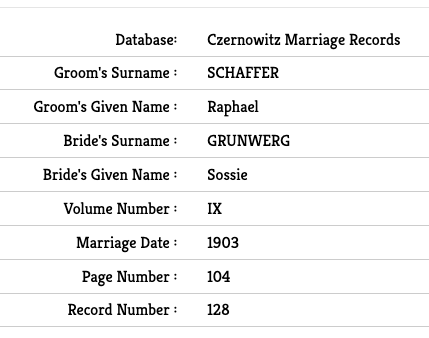
Like the Viennese Jewish records, some Jewish Czernowitz vital records listed in the FamilySearch catalogue have not been indexed. I looked for the indexed marriage record in the GeneaSearch Czernowitz database and found it.
I then took this information to the FamilySearch catalogue to view an image of the original record. Czernowitz records may be searched and viewed on FamilySearch from one's home computer, but one may not download the images (a screen shot is not optimal, but worked for me).


Extract: Groom: Raphael Schaffer, born in Radautz, son of Abraham Schaffer and Rifke Liebross of Radautz. Born 1 April 1875. Bride: Sossie Grunwerg born in Kolomea, daughter of Berl Grunwerg and Sura, born Frank, in Czernowitz on 20 November 1880. [5]


Extract: Married on 6th September 1903 in Czernowitz. Rabbi Benjamin Weiss.

Evidence in this record addresses the problem of Herta's mother's name. Sossie was identified with her mother's last name (Frank), not her father's (Grunwerg). To be sure, I located Sossie's birth record via the Jewish Records Indexing- Poland database.[6]


Extract/summary: Sossie, born in Kolomea on 18 November 1880 [her marriage record showed 20 Nov. 1880]. She is shown as illegitimate and her father's information is not included in the last column on this page. A note above the illegitimate notation indicates that her parents married in Czernowitz on 5 May 1888, thereby legitimizing her.


Extract: Mother's name was Sura Frank. Sossie's father's name, Berl Grunwerg of Kolomea is recorded in the first column under her mother's name. Sura's parents were Meier and Ester Rifka Frank of Kolomea.

She, like Rafael, was listed as illegitimate. Her parents married civilly after her birth.

I did find Sossie's parents' marriage record from 1888 among the Czernowitz  Jewish marriage records, but will not include it here. It shows that her mother Rifka's surname had been Udelsman (perhaps Rifka's mother's maiden name!).

It appears I have located a new 3rd cousin (CS) and his son (JS), who is my 3rd cousin once-removed. Now, I have other record-confirmed 3rd cousins+ on this side of the family with whom I share no autosomal centiMorgans. So, these matches with CS and JS are special. I hope to get more of my clear-cut Ancestry matches' results uploaded to other websites to allow more in-depth analyses.

Mane and Tsiril had four children (that I know of). Rifke Liebross Schaffer had nine or ten. Louis had at least eight. So the family tree below just shows our direct lines from our common ancestral couple.

For those who sometimes question the value of DNA testing for one's family history, note that in this case DNA results allowed me to find a person for whom I was not previously searching. Without the initial interesting match with CS I would not have looked further. And without the availability of indices and images of European Jewish records I never could have made this connection. It takes a village of websites and organizations to build a family tree. 

In addition to CS, JS and all my cousins whose curiosity and trust allow me access to their DNA test results, I think kudos are due to GeneaSearch, Edgar Hauster and Bruce Reich (who are behind the acquisition and indexing of Radauti Jewish vital records), JewishGen, Jewish Records Indexing-Poland, and FamilySearch. And of course, let's not forget the big four DNA testing companies: Ancestry, FamilyTree DNA, MyHeritage and 23andMe. With patience DNA tests are gifts that keep on giving.

Notes:
1. Radauti Jewish Marriages, Abraham Ber Schaffer and Rifke Libruss, 24 June 1877, Vol. 1, p. 64, entry 36; Radauti City Archive. Indexed records searched at: https://czernowitz.geneasearch.net/
2. Radauti Jewish Births, Rafael Schaffer, 1 April 1875, vol. 1, p. 83, entry 30; Radauti City Archive. Indexed records searched at: https://www.reisch-family.net/RadautzBirthRegistersIndex/BirthsSearchForm.html
3. I have been in touch with one descendant of Rifka Liebross Schaffer who lives in Israel who has been very helpful.
4. Vienna, Jewish births 1917, no. 282, Herta Schaffer, 19 February 1917; images, FamilySearch (https://familysearch.org: accessed 2 October 2019), "Metrikel 1826-1943,">Geburten 1917-1918 (microfilm 1199227); citing Judische Gemeinde Wien (Niederosterreich), Stadt und Landesarchiv Wien.
5. Czernowitz, Jewish marriages 1903, Raphael Schaffer and Sossie Grunwerg, 6 September 1903; images, FamilySearch (https://familysearch,org : accessed 2 October 2019), Austria, Bukovina, Czernowitz - Jewish Records>Metrikel Books, 1856-1940>microfilm 2395731, Item 1>image 73 of 850; citing Central State Historical Archives of Ukraine, Czernowitz, vol. IX, p. 104, record 128.
6. Kolomyya, , Jewish births, Sossie [Grunwerg] Frank, 18 November 1880; images, Polish State Archives, AGAD, Stanislowow Wojewodztwo, Kolomyya, Fond 300, Signatura 395, Akta 670; accessed via Jewish Records Indexing-Poland (https://jri-poland.org/ ).